
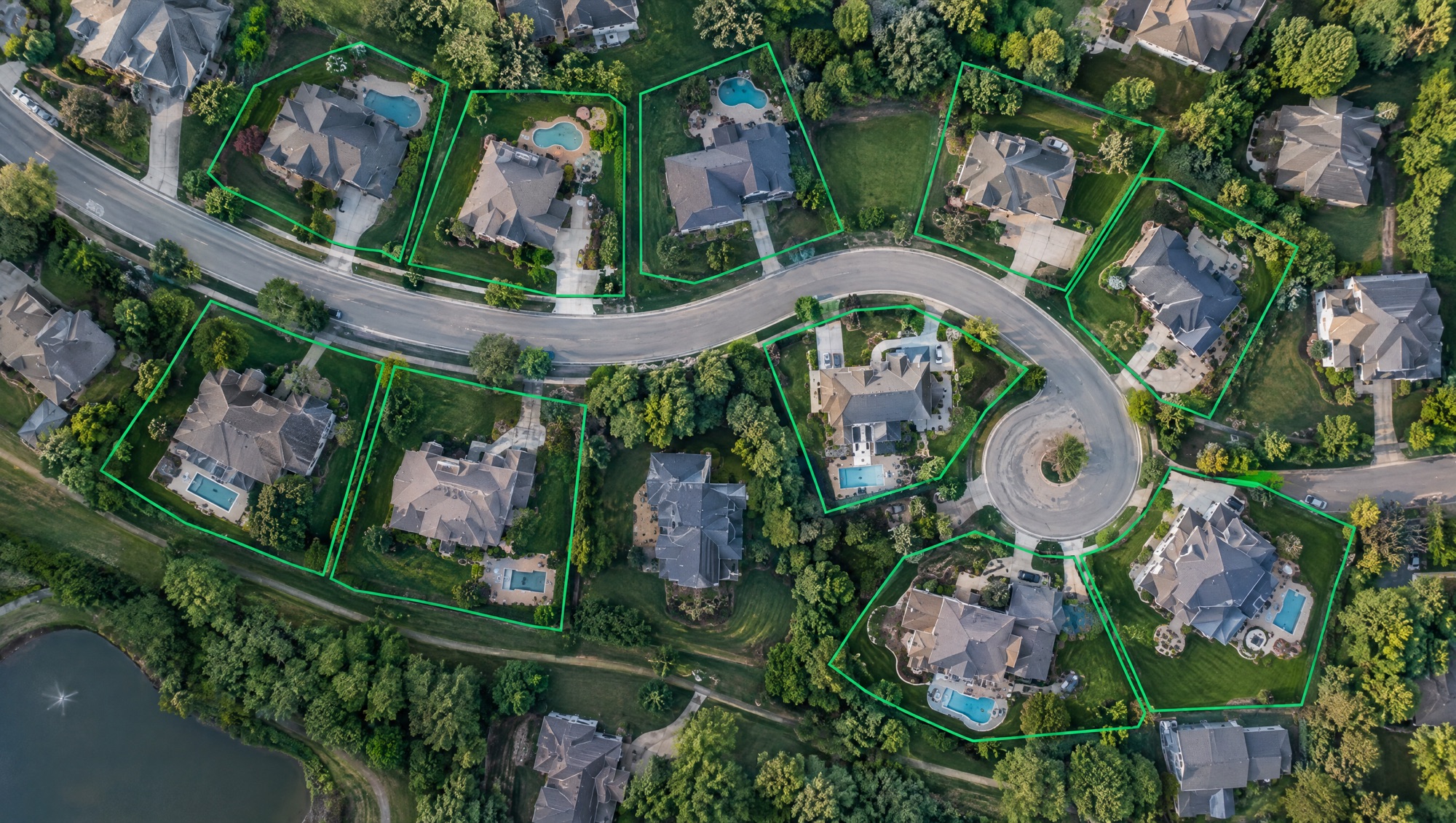
This is the real bread and butter
Most of what people picture when they hear geofencing is a fence around a building. A competitor's store, a stadium, a hospital.
Addressable geofencing is the version I'd point most businesses at first, and it works differently. Instead of one fence around one building, we put a fence around individual home addresses. Hundreds of them, or thousands, each one its own boundary.
Think of it as a digital version of direct mail.
The direct mail comparison, because it isn't a metaphor
Direct mail has always worked on selects. You go to a data provider and say: households in these zip codes, head of household 55 or older, household income above $100,000, homeowner, net worth in this band. They hand you a list of addresses. You mail to that list.
Addressable geofencing uses the exact same lists. The same selects, the same providers, often the literal same file. The difference is what we do with it. Instead of putting a postcard in the mailbox, we geofence every household on that list and advertise to the mobile devices inside those homes.
That's why it pairs with direct mail so cleanly. The postcard shows up once a month. The digital ads run continuously against the same households. Same family, two channels, one list.
Most of my clients don't run direct mail at all. They just want the targeting precision those lists provide, without the print and postage. That works too.
What a radius can't do
The standard alternative is a radius. Draw a five-mile circle around your business and advertise inside it.
A radius treats every household in the circle as the same household. The 2,000 homes that match your customer profile and the 40,000 that don't all cost you the same per impression.
Addressable targets the 2,000 and skips the 40,000.
That's the entire difference, and it's the difference between a campaign that works at a small budget and one that needs a large budget to overcome its own waste.
What you can actually select on
- The standard demographic and financial selects. Age, household income, net worth, homeownership, length of residence, presence of children, home value.
- Ownership and possession. Households with a swimming pool. Households that own a BMW. Households with a golden retriever. If somebody sells pool service, fencing every pool-owning household in a county beats anything a platform's interest targeting will produce.
- Interests and lifestyle. The usual behavioral categories, at the household level rather than the guessed-at individual level.
- Purchase intent and preference. I work with data partners who can build address sets on intent. Not just what a household has, but what it's leaning toward. Whether it tends to choose luxury over convenience, or the reverse. Whether it's in the consideration window for a category.
That last one is the piece most people don't know exists. You can build an audience of households that are financially, demographically, and behaviorally right, then narrow it to the ones whose preferences match how you actually sell.
What happens once the list is fenced
Two things, and the second is the one people miss.
Your ads run against the devices in those households across the open web. News, weather, health, sports, games, apps. The same inventory everyone buys, pointed at a list you curated.
We capture the mobile device IDs inside those households and match them to social accounts. Facebook, Instagram, LinkedIn. The match rate runs around 40 percent, which means a meaningful share of your address list becomes a social audience too.
So one address list produces a display campaign and a social campaign against the same families. That capability isn't unique to addressable, it works on any geofenced audience, but it's unusually valuable here because the households were chosen rather than stumbled into.
Who it works for
Senior living. This is where addressable geofencing earned its place at Canopy. The whole industry ran on direct mail for decades, and addressable was the digital version that fit without anybody rebuilding their strategy. The full story on senior living is here.
Anybody already buying direct mail. If you've got a list, you've got a campaign. The list is the hard part and you already paid for it.
High-consideration purchases. Things people research for months. Roofing, HVAC replacement, financial services, private school, elective procedures. You want to be visible during the consideration window, not just at the moment of search.
Businesses with a definable customer profile. If you can describe your best customer in terms of what their household looks like, that description is buildable as a list.
Accuracy and what to expect
Addressable is significantly more precise than a radius because it targets at the property level rather than by proximity. That's the honest framing.
What it doesn't do is guarantee a specific person. We're targeting devices inside a household, not an individual by name. In practice that's usually fine and sometimes better, since the person researching senior living for a parent and the person who'll write the check are frequently in the same house.
Pricing works differently too, because we can't forecast device counts for addresses the way we can for buildings. We price off the address count: 5,000 addresses at 40 impressions each is 200,000 impressions, which at $9 per thousand is $1,800 a month. Full pricing detail here.
How to build a good address list
- Start from your existing customers. What do their households have in common? That profile is your select criteria.
- Don't over-narrow. Stacking eight selects can cut a list to a few hundred homes, too small to produce meaningful reach. Two or three strong selects usually beat six weak ones.
- Use the list you already have. If you're running direct mail, send me that file. No new data purchase required.
- Refresh it. Households move and circumstances change. A list that worked eighteen months ago isn't the same list today.

Have a list, or want one built?
I'll show you what's available in your market. About 15 minutes, no pitch.