
The short version
Geofencing is advertising that reaches people based on where their phone has actually been.
That's the whole idea. You pick a real place on a map. A competitor's store, a hospital, a stadium, a conference center, a list of home addresses. We draw a boundary around it. Phones that cross that boundary get added to an audience, and your ads follow those people from there.
Most advertising works the other way around. You guess at an age range and an income bracket, you tell a platform to go find those people, and you pay for the guess. Geofencing skips the guess. You already know where your customers physically show up, and that's a better starting point than a demographic profile. It's the one thing geofencing is built on.
It isn't complicated, and it isn't new. It's just not something most of your competitors have gotten around to using.
How we actually build a fence
We open Google Maps and look at the physical location you want to reach. A competitor's building, a football stadium, a single house.
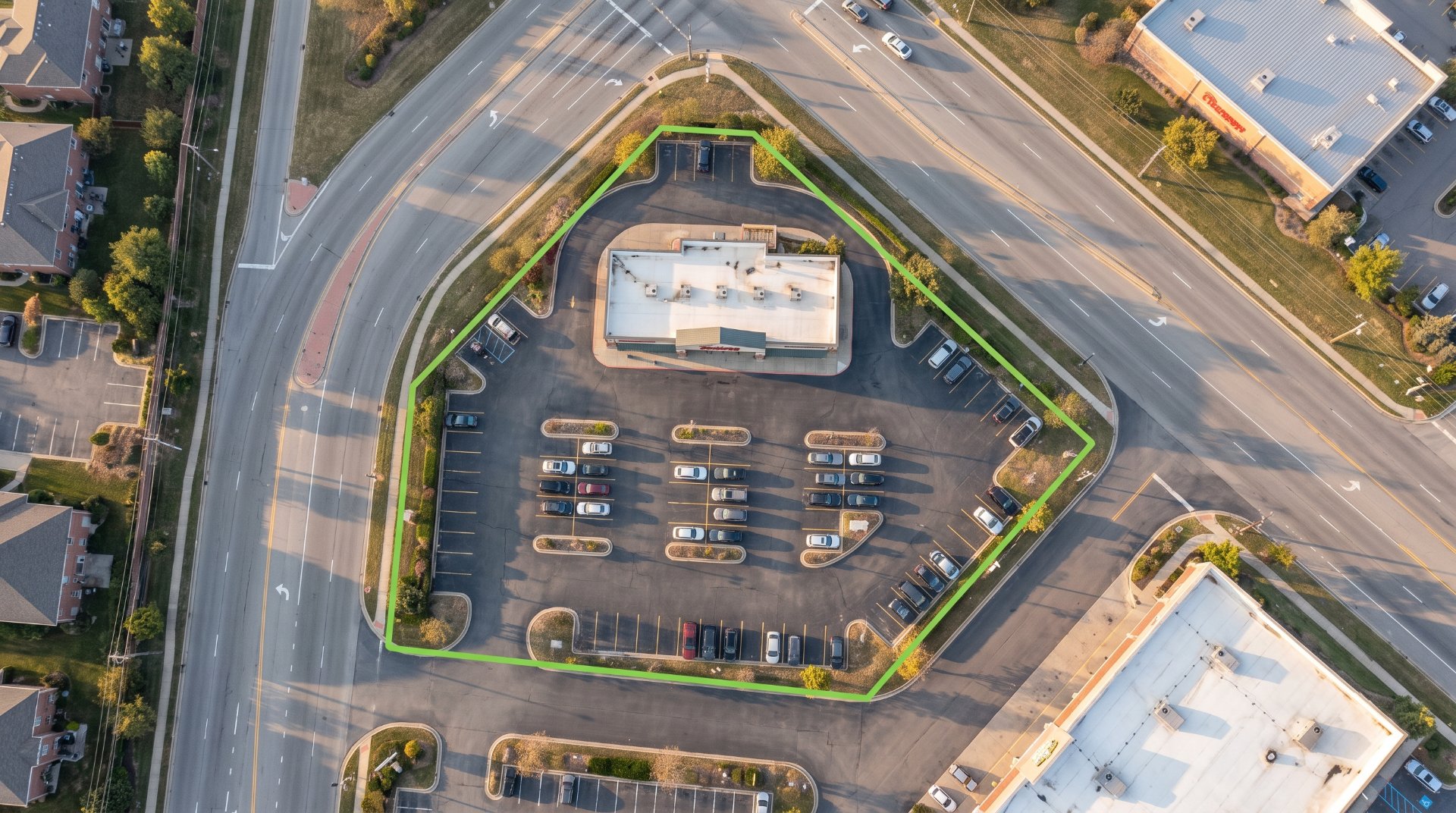
We draw a sixteen-point polygon around it. Not a circle, not a radius, and not a preset shape the software picked. A polygon shaped by hand around the actual building.
We do it by hand because of what a loose fence catches. A radius pulled around a business doesn't know the difference between the business and the four-lane road running past its front door, or that the parking lot is shared with a grocery store. Draw it loosely and you capture every car that sat at the light and every person buying milk. Those devices cost exactly the same per impression as a real prospect, so a loose fence doesn't just add noise. It drains the campaign.
That polygon becomes a set of latitude and longitude coordinates, saved into a file called a GeoJSON. One fence can hold thousands of coordinates. A campaign can hold thousands of fences. That file is what the ad platform reads.
What happens when a phone crosses the line
This is the part that sounds like magic and isn't.
Open ESPN on your phone to check a score. The ads show up a beat after the content does. That beat is the whole auction.
In that fraction of a second, ESPN sends an ad call up to the ad networks: there's a device here, in this location, with this browsing and location history, opening this page, and I need a 300x250 display ad served to it right now.
We're sitting at that ad network. If that device is one we've seen inside one of your fences, we bid on it. In real time, while the page is still loading. We win about one out of every three bids.
The interesting part is what happens with the ones we don't win. We've still seen them. The device ID is captured whether we served an ad in that moment or not, and that device stays reachable for 45 days from the day we see it, no matter where it goes. It leaves the stadium, drives home, sits on a couch in a different county, and it's still in your audience. A live fence keeps feeding new devices in the whole time it's running, which is why your ads keep running against a full audience for the length of the campaign.
That's what you're actually buying. Not an ad delivered at the moment somebody stands in a parking lot. An audience of real devices that were at a place you care about, reachable afterward, wherever they went.
What a campaign looks like from there
Once the audience exists, it behaves like any other advertising audience.
Your ads run as display, video, and social, for the length of the campaign. They show up in the apps and sites those people already use. CNN, WebMD, Facebook, Instagram, games, news sites, weather apps. The same inventory every other advertiser is buying. The difference is who's on the other end of it.
You don't have to serve the same ad to everybody either. A conference audience and a competitor-parking-lot audience are two different groups at two different moments, and the creative can say two different things.
What it costs to try
You pay by the thousand impressions, the way you would for any programmatic display buy. My rate is $9 per thousand for display, and $17 per thousand for social.
That turns into a real number because we can forecast device volume before you spend anything. We pull how many unique mobile devices have actually been at each location on your list over the last 30 days, then plan for roughly 40 impressions per device over a 30-day flight.
That's a real campaign at a real number, and you see the device counts before you commit to anything. The full pricing breakdown is here, including how addressable geofencing is priced differently.
There's no minimum spend and no contract.
Three things geofencing is not
- It isn't texting people. Nobody gets a message because they walked into a building. Geofencing serves ads in apps and on websites, the same as any other display campaign. The person sees an ad. That's the entire interaction.
- It isn't tracking individuals by name. We work with anonymized mobile device IDs. No names, no phone numbers, no personally identifiable information about any individual. We know a device was at a location. We don't know whose it is, and we don't want to.
- It isn't only for retail. Foot traffic is the easiest version to picture, so it's the one people assume. But senior living, recruiting, multifamily, healthcare practices, trades, and B2B events all run on the same mechanism. If your customers go somewhere in person, and they do, this works.
What to ask an agency before you start
- Do you draw the fences by hand? A lot of platforms serve up predetermined hexagonal shapes over an area and call it geofencing. That's a different product. Ask whether somebody is looking at your locations on a map and shaping each fence around the actual building.
- How far back can you go? Historical targeting is standard. Ask for the window and an honest answer about where the data gets thin. Mine is 90 days.
- Can I use this audience on social? Most people assume geofencing means display only. If the answer is yes, that roughly doubles what the audience is worth to you. More on that here.
- How will I know it's working? Ask before you sign, not after month one. Conversion zones, call tracking, UTM parameters, form fills. An agency that doesn't have those answers ready is telling you something.
- What's the minimum? If there's a contract or a floor, ask why.
The honest summary
Geofencing isn't voodoo, and it isn't CIA magic. It's a boundary on a map, a file of coordinates, a real-time auction, and an audience of devices that were somewhere specific.
What makes it work or not work is almost never the technology. It's whether somebody took the time to draw the fences around the right buildings, and whether anybody set up a way to measure what happened next.

Curious what's actually fenceable in your market?
About 15 minutes, no sales pitch, and you get a strategy deck with real device counts for your area whether we work together or not.