
If you're already paying for this and it isn't working
I talk to people in this situation regularly. They tried geofencing, or they're running it right now with somebody else, and the results aren't there. Usually they've concluded that geofencing doesn't work.
It's almost never that. In my experience it comes down to two things, and both are fixable.
Problem one: "geofencing" is a broad term and you may not be buying what you think
This is the big one.
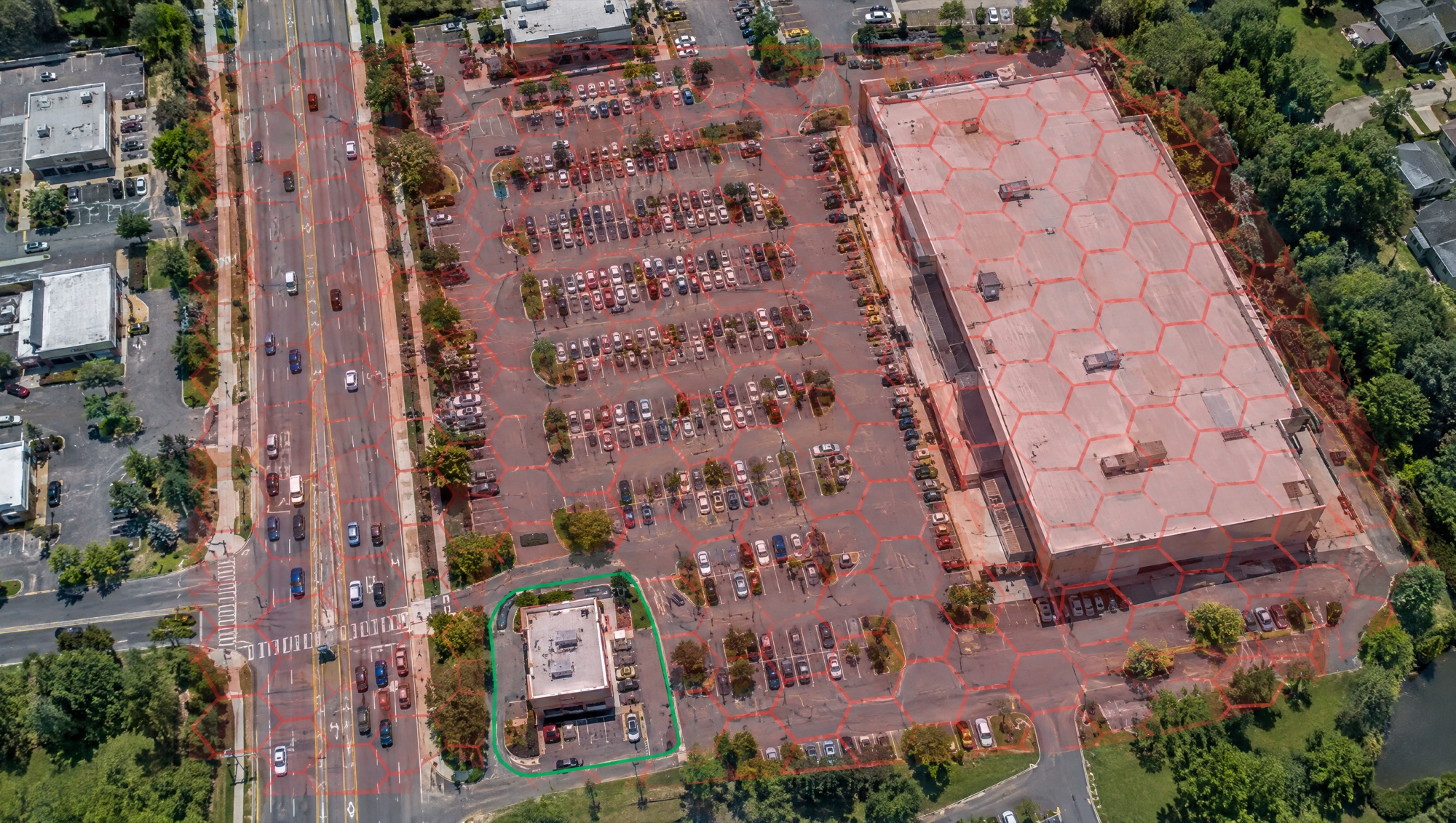
Geofencing has become a word covering a range of products that aren't the same product. A lot of agencies and digital media companies offer geofencing in its broadest sense, which in practice means the platform serves up predetermined hexagonal shapes laid over an area, and those become your "fences."
That isn't what I do here, and the difference isn't cosmetic. We hand-draw every fence. I open Google Maps, look at the actual physical location, and shape a polygon around that building specifically.
Predetermined shapes laid over the map. Whatever falls inside them becomes your audience.
Shaped around the actual building you picked, on Google Maps.
We do it that way because of what you catch when you don't.
- Busy streets. A preset shape that overlaps a four-lane road captures every car that sat at the light.
- The business next door. A fence that spills onto a busy grocery store captures everybody who went for milk.
- Shared parking lots. The worst one. A competitor inside a strip mall shares a lot with six other businesses, and a loose fence captures all six businesses' customers and calls them your audience.
Those devices have nothing to do with why you picked that building, but they're in your audience now and they cost exactly the same per impression as a real prospect. They become an impression suck, draining the budget on people who were never the point.
You don't see this in the reporting. Delivery looks fine. Impressions are pacing. The CPM is what you agreed to. The campaign appears healthy and produces nothing, because a large share of the audience was never your audience.
How to check: ask your provider to show you the fences. On a map. A hand-shaped polygon around each building is good. A hex grid, a radius, or no map at all is your answer.
Problem two: nobody set up a way to know
The second reason is that the campaign may be working and there's no mechanism to see it.
This starts with a question that should have been answered before launch and frequently wasn't: what are we actually trying to do here?
Driving foot traffic? Then there should be a conversion zone around your locations, and the platform has to be able to track devices into it. Not every platform can. If yours can't, foot traffic is unmeasurable and you'll never prove the thing you were trying to do.
Driving website traffic and calls? Then there has to be instrumentation for it, and this is where most campaigns quietly fail. When display traffic from a mobile device hits your site, Google Analytics often can't tell where it came from and throws it into the "direct" bucket, mixed in with everyone who typed your URL. Judge the campaign on Google Analytics alone and a working campaign can look like nothing happened.
Fixes, both of which should have been in place at launch:
- UTM parameters on the geofencing ads. This tracks that traffic deeper into the campaign rather than watching it vanish into "direct."
- Call tracking. If your business gets business over the phone, untracked calls are untracked conversions. The campaign may be producing them right now and nobody would know.
More on measuring this properly.
The other things worth checking
- Success was never defined. If nobody wrote down what success looks like before launch, month three becomes an argument instead of an evaluation.
- Fencing where customers are instead of where they decide. Your customers are at the grocery store. So is everyone. Fence the places that signal something: a competitor, a specialist's office, an event, a hospital.
- Flights too short to read. My standard is 40 impressions per device over 30 days. A two-week flight at half the frequency hasn't given anyone the chance to notice you.
- Judging it on clicks. Display click-through rates are low by nature. The person who eventually converts often never clicked at all.
- Sending traffic to a page that can't convert. A working campaign pointed at a weak landing page produces traffic and no leads. That reads as an ad problem and isn't one.
- Creative that doesn't fit the moment. The same ad served to a conquesting audience and a past-event audience is speaking to two very different people as if they were one.
Audit your own campaign in 20 minutes
Six questions. Ask your current provider.
- Show me the fences on a map. Hand-drawn polygons around specific buildings, or preset shapes over an area? This one question resolves most cases.
- Are any fences overlapping busy roads, shared parking lots, or neighboring businesses? Look at them yourself on Google Maps. You'll be able to tell.
- Are the ads carrying UTM parameters? Click one of your own live ads and look at the URL. No parameters means your traffic is going into "direct."
- Is call tracking in place? If not, and your phone is how you get business, you have no conversion data.
- Is there a conversion zone on my locations? If foot traffic was the goal and the answer is no, the goal is unmeasurable.
- What was success defined as before launch, and where is that written down? If nobody can produce it, that's the finding.
If three or more come back wrong, the campaign never had a fair chance, and the problem isn't geofencing.
What a correctly built campaign looks like
Fences hand-drawn around specific buildings, checked on a map for overlap with roads, neighbors, and shared lots. A device forecast built before anyone spends money. A defined goal with matching measurement: conversion zones for foot traffic, UTM parameters and call tracking for web and phone. Enough flight length and frequency to register. Creative matched to the audience. A monthly read on which fences produced, and a willingness to cut the ones that didn't.
None of that is exotic. It's the difference between geofencing as a real discipline and geofencing as a checkbox on a services page.

Running geofencing now and it isn't producing?
I'll look at it with you. About 15 minutes, no pitch, and if the campaign is fundamentally sound I'll tell you that instead of pitching you a replacement.